Are you thinking about a tummy tuck in Vancouver? A Tummy Tuck, also known as Abdominoplasty, is a cosmetic surgery procedure used to improve the shape of the tummy area (abdomen) by removing excess fat and loose skin.
It can create a firmer profile by restoring weakened muscles. If eating healthy and dieting have been unsuccessful, a tummy tuck may be an option for you.
Even if you have a normal body weight, you may have a tummy that is sagging or loose. This may be due to pregnancy, aging, fluctuations in weight, and even heredity.
Am I a Candidate For Tummy Tuck Surgery?
A Tummy Tuck is not a substitute for proper exercise and a healthy diet, however, anybody with excess abdominal fat and skin may be a candidate. With women, pregnancy is a common cause of the problem, but is aggravated by weight loss. Men are affected similarly by weight loss.
The result of significant weight loss is unsightly stretch marks which are most obvious on the lower tummy area. These stretch marks can be made less obvious with the abdominal reduction procedure.
Large fluctuations in body weight can impact the results of a Tummy Tuck. If you are expecting significant weight loss or planning a pregnancy, you would be advised to delay a Tummy Tuck procedure.
You should have realistic expectations and you shouldn’t be doing it to fulfill anyone else’s desires of what an ideal image should be.
During your consultation, you may be asked to discuss your current medical condition, previous surgeries, medications you are currently taking, and your goals.
After you are evaluated, we will discuss your options and recommend a course of treatment, as well as discuss the risks and complications involving the procedure. You may also be asked to stop smoking or taking certain medications.

Tummy Tuck Procedure
Anesthesia is administered before surgery so you are comfortable during the procedure. The surgery is usually done under a general anesthetic.
The two types of Tummy Tucks are a Partial Tummy Tuck and a Full Tummy Tuck.
In a partial Tummy Tuck, a large incision is made across the lower abdomen, and the skin is separated from the abdominal wall. Excess fat and skin is cut away and the remaining skin is pulled together and stitched up.
In a full Tummy Tuck, an incision is made across the lower abdomen, and a second incision is made to free the belly button from the surrounding tissue. Excess skin and fat are then removed. A new opening is created for the belly button, and is stitched back into position.
The remaining skin is finally pulled down and stitched together.
Depending on the extent of the surgery and surgical techniques used, the operation could take up to three hours to complete.
If you are interested in a mini tummy tuck, please contact us to book a consultation.
Recovery After Tummy Tuck Surgery
If your Tummy Tuck is performed on an outpatient basis, arrange for someone to drive you home after recovering from surgery.
After your surgery, dressings may be applied to your incisions and an elastic bandage may be wrapped around the tummy to encourage your skin to heal properly around the affected area. You also will be given instructions on how to care for the surgical site.
Medication may be prescribed to help with the healing process and you will be told when to follow up with your doctor.
Ask your plastic surgeon questions about what you can expect during the recovery period.
Tummy Tuck Surgery Results
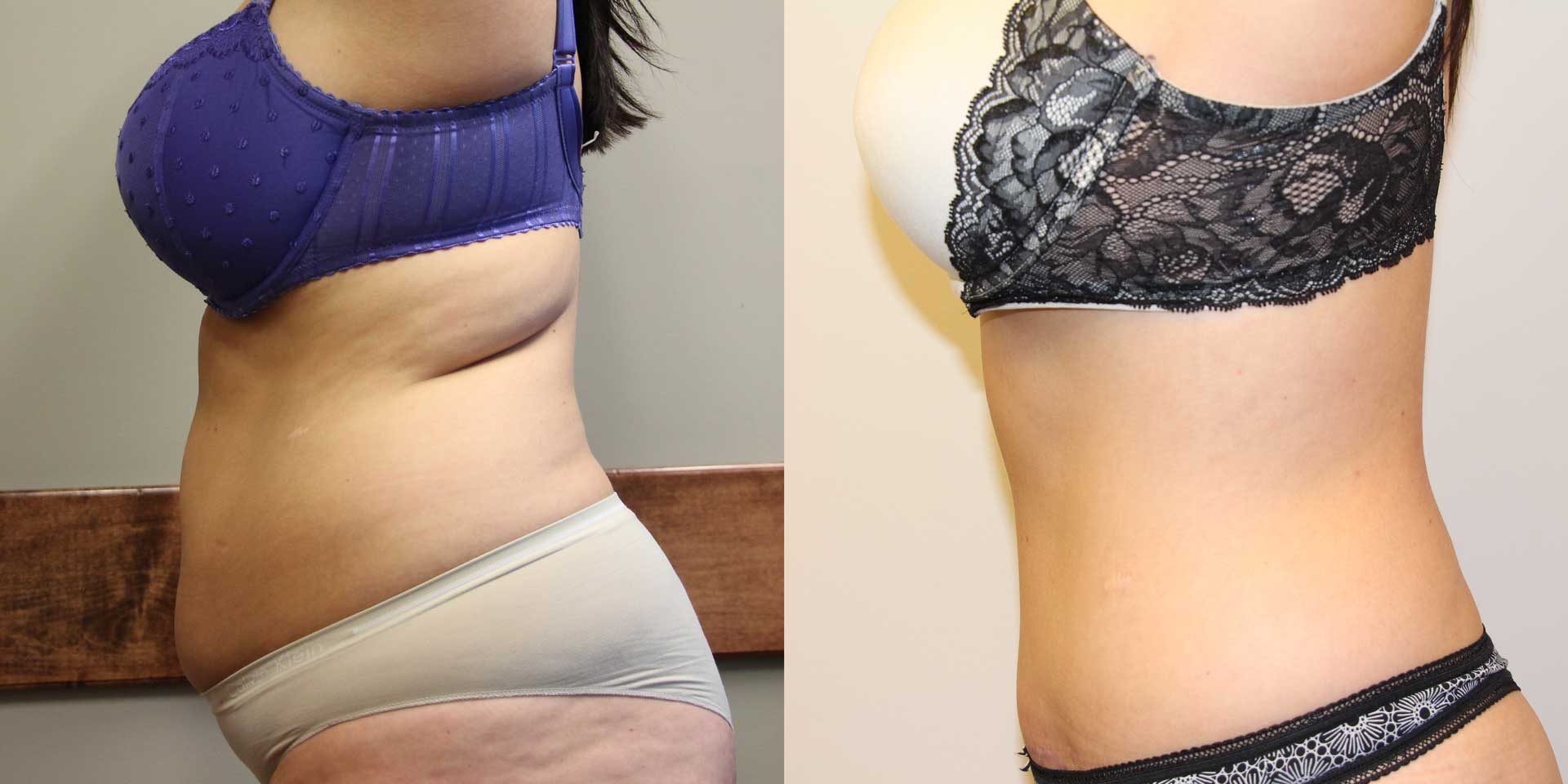
You may find that you might be unable to stand fully upright until healing is complete, however, this will improve over time. If you have had previous surgery in the abdominal area, it may limit the results of a Tummy Tuck.
Scars may take several months to improve in appearance and existing scars may be incorporated into new scars.
As with most cosmetic procedures, it may not always be possible to achieve optimal results with one visit, and another surgery is sometimes necessary in some cases.
Abdominoplasty Risks and Complications
A Tummy Tuck is an extremely personal decision and you will need to weigh the risks and benefits. To make sure you understand the risks involving the procedure, you will be asked to sign consent forms before the surgery.
Examples of the risks involving abdominoplasty include the following:
- Infection
- Skin loss and discoloration
- Deep vein thrombosis
- Asymmetry and scarring
- Persistent pain and poor wound healing
- Numbness
It’s important to address any questions that you may have concerning the procedure and these risks with your plastic surgeon.
Cost of a Tummy Tuck in Vancouver, BC
The cost of a tummy tuck procedure depends on the type of procedure performed, as such, prices will vary.
The average cost for a tummy tuck is $13,000 CAD + GST.
Financing plans are offered.
Watch Dr. Anzarut’s Video on Tummy Tuck Surgery
Frequently Asked Questions (FAQ)
1. What is a Tummy Tuck (Abdominoplasty)?
A Tummy Tuck, clinically known as Abdominoplasty, is a comprehensive body contouring surgery designed to excise redundant, sagging abdominal skin (panniculus) and remove stubborn subcutaneous fat. Crucially, it involves muscle plication—suturing the underlying rectus abdominis muscles back together to repair diastasis recti caused by pregnancy or massive weight loss. This surgical tightening creates a firm, flat internal abdominal wall and a sleek, contoured waistline that diet and core exercises physically cannot achieve.
2. How much does a Tummy Tuck cost in Vancouver, BC?
In Vancouver, an Abdominoplasty typically ranges from $11,500 to $18,000 CAD. A Mini Tummy Tuck rests on the lower end, while a complex Lipo-abdominoplasty or Fleur-de-Lis procedure for massive weight loss patients will be higher. This comprehensive fee encompasses the FRCSC surgeon’s expertise, the FRCPC anesthesiologist, operating room time at our NHMSFAP-accredited facility, and your post-operative compression garments. We partner with Beautifi to provide manageable medical financing for our Lower Mainland patients.
3. Is Abdominoplasty covered by the BC Medical Services Plan (MSP)?
A cosmetic Tummy Tuck is an elective procedure and is never covered by the Medical Services Plan (MSP) of British Columbia. In exceedingly rare cases of massive weight loss, MSP may cover a functional panniculectomy—the strict removal of the hanging skin apron to treat chronic rashes. However, a panniculectomy does not include aesthetic contouring, liposuction, or repairing diastasis recti. True aesthetic abdominal rejuvenation is entirely a private-pay surgery.
4. What is the difference between a Mini and Full Tummy Tuck?
A Full Abdominoplasty addresses the entire abdominal wall, requiring an incision from hip-to-hip and a secondary incision to reposition the belly button (umbilicoplasty). It repairs the core muscles from the sternum to the pubis. A Mini Tummy Tuck requires a shorter incision and only removes a small amount of loose skin exclusively below the navel, without repositioning the belly button. It is ideal for lean Vancouver patients with minimal lower abdominal laxity.
5. Does a Tummy Tuck fix Diastasis Recti?
Yes. Diastasis recti is the vertical separation of the rectus abdominis muscles (the “six-pack”), universally caused by the expanding uterus during pregnancy. No amount of Pilates or core training can fuse this stretched connective tissue (linea alba) back together. During a full abdominoplasty, your surgeon performs muscle plication, permanently suturing the muscle bellies back to the midline like an internal corset, profoundly restoring core strength and narrowing the waist.
6. What is a Lipo-Abdominoplasty?
A Lipo-Abdominoplasty seamlessly combines the skin excision and muscle repair of a traditional tummy tuck with advanced liposuction of the flanks, waist, and upper abdomen. By extracting stubborn subcutaneous fat surrounding the surgical site, the surgeon can comprehensively sculpt a three-dimensional, hourglass silhouette. This aggressive contouring approach delivers vastly superior aesthetic results compared to skin removal alone, ensuring a smooth, athletic transition from the ribs down to the hips.
7. What is a Fleur-de-Lis Abdominoplasty?
A Fleur-de-Lis (FDL) Abdominoplasty is an advanced surgical technique explicitly designed for massive weight loss or post-bariatric patients in Vancouver. Because severe weight loss creates significant vertical and horizontal skin laxity, a standard horizontal bikini-line incision is insufficient. The FDL approach adds a vertical incision down the center of the abdomen, allowing the surgeon to excise massive amounts of redundant tissue from the sides, creating a tight, contoured abdomen despite severe initial laxity.
8. Where will my Tummy Tuck scars be located?
A full abdominoplasty requires a horizontal incision placed low on the pubic area, extending laterally toward the hips. An expert FRCSC plastic surgeon strategically designs this incision so the resulting scar is perfectly hidden beneath a standard bikini or underwear line. You will also have a small, discreet scar hidden inside the newly created belly button (umbilicoplasty). While permanent, these scars fade into pale, flat lines over 12 to 18 months.
9. What kind of anesthesia is used for a Tummy Tuck?
Because an abdominoplasty involves extensive skin excision and deep fascial muscle plication, it is exclusively performed under General Anesthesia. You will be completely asleep, paralyzed, and comfortable. In our Vancouver surgical center, your sedation is managed strictly by a Board-Certified Anesthesiologist (FRCPC). They utilize an endotracheal tube to secure your airway and meticulously monitor your vitals, core temperature, and fluid balance, ensuring the highest standard of intraoperative safety.
10. Will I need surgical drains after my procedure?
Most comprehensive tummy tucks require one or two closed-suction Jackson-Pratt (JP) drains for the first 5 to 10 days. These small plastic tubes prevent the accumulation of fluid (seroma) and blood (hematoma) in the dead space between the skin and muscle. Some specific techniques allow for a “drainless” tummy tuck using progressive tension sutures, but standard drains remain the safest, most reliable method to ensure a smooth, complication-free recovery.
11. How long is the recovery time for a Tummy Tuck?
Vancouver patients typically plan for 2 to 3 weeks off desk work. The first week requires sleeping in a “beach chair” position and walking hunched over to avoid tension on the abdominal closure. You will be highly restricted in your mobility. Driving is prohibited while taking prescription narcotics. By week three, you will stand up straight, but heavy lifting and core-engaged exercise remain strictly banned for 6 to 8 weeks to protect the internal sutures.
12. Why do I need to wear a compression garment?
You will wake up in a specialized medical compression garment (a faja or abdominal binder). You must wear this 24/7 for the first 4 to 6 weeks. Post-operative compression is critical; it actively minimizes severe fluid retention (edema), helps the newly redraped skin adhere smoothly to the underlying fascia, and provides essential physical support to your freshly repaired rectus abdominis muscles when you cough, sneeze, or move.
13. Can I get pregnant after an Abdominoplasty?
While it is medically safe to carry a pregnancy to term after a tummy tuck, we strongly advise against it for aesthetic reasons. A future pregnancy will inevitably restretch the abdominal skin, create new striae (stretch marks), and physically tear apart the internal muscle plication (diastasis repair) achieved during surgery. To protect your surgical investment, we mandate that Vancouver patients be entirely finished building their families before undergoing this procedure.
14. What is an Umbilicoplasty?
An umbilicoplasty is the surgical reshaping of the belly button. During a full tummy tuck, the abdominal skin is pulled downward, covering the original navel. The surgeon must cut a new hole in the tightened skin and pull the original umbilical stalk through, meticulously suturing it into place. Masterful surgeons focus heavily on umbilicoplasty, creating a natural, slightly hooded “innie” to avoid the telltale “coin-slot” look of a poorly executed tummy tuck.
15. Will a Tummy Tuck remove my stretch marks?
Yes, but only those located on the excised skin. A standard abdominoplasty removes the vast majority of the skin located between the belly button and the pubic bone. Therefore, any striae (stretch marks), C-section scars, or lower abdominal tattoos located within this specific zone will be permanently removed. Stretch marks located above the belly button will remain, but will be pulled lower and flattened, making them significantly less noticeable.
16. How do you manage pain after a Tummy Tuck?
The pain primarily stems from the deep muscle plication, which feels like an intensely severe core workout ache. We manage this comprehensively. In the OR, the surgeon may inject long-acting local anesthetics (like Exparel) directly into the rectus fascia to block pain signals for the first 72 hours. You are also sent home with a customized regimen of oral narcotics, Tylenol, and crucial muscle relaxants to stop painful abdominal spasms.
17. What are the medical risks of Abdominoplasty?
When performed by an FRCSC expert, risks are low but include seroma (fluid accumulation), hematoma, infection, and thick, hypertrophic scarring. The most critical risks are Deep Vein Thrombosis (DVT) and tissue necrosis (skin death near the incision). We mitigate these by operating in an NHMSFAP-accredited facility, utilizing SCD compression boots in the OR, enforcing early walking to prevent clots, and strictly banning all nicotine use prior to surgery.
18. Why is BMI important for a Tummy Tuck?
Patient safety is our priority. Most accredited private surgical facilities in BC enforce a strict Body Mass Index (BMI) limit, typically under 30. An elevated BMI significantly increases the risk of life-threatening anesthetic complications, DVT, and severe post-operative infections. Furthermore, high intra-abdominal fat (visceral fat) physically prevents the surgeon from stitching the core muscles tightly together. You must be at a stable, healthy weight to undergo contouring safely.
19. Can I combine a Tummy Tuck with a Breast Lift?
Yes, combining an Abdominoplasty with a Mastopexy (Breast Lift) or breast augmentation is universally known as a Mommy Makeover. This combination is incredibly popular among Vancouver mothers, as it completely restores the pre-pregnancy silhouette in a single operation. While it requires a slightly longer recovery, combining surgeries means you endure only one general anesthetic fee, one facility fee, and one unified period of social downtime.
20. How do I choose the best Tummy Tuck surgeon in Vancouver?
Never compromise on your body. Ensure your surgeon is a Fellow of the Royal College of Physicians and Surgeons of Canada (FRCSC) in Plastic Surgery. Verify their standing with the College of Physicians and Surgeons of BC. When reviewing their gallery, scrutinize the aesthetic quality of the belly button (umbilicoplasty) and ensure the horizontal scars are low, thin, and symmetrical. A master surgeon leaves a natural, athletic contour, not a boxy torso.
Book a Consultation Today
Service Area Locations
Dr Anzarut Plastic Surgery in Vancouver serves Kitsilano, Burnaby, Coquitlam, New Westminster, Richmond, Surrey, Delta, North Vancouver, West Vancouver, Langley, and White Rock in Metro Vancouver (Lower Mainland), British Columbia.
Dr Anzarut Plastic Surgery in Duncan serves Victoria, Nanaimo, Courtenay, Campbell River, Parksville, Port Alberni, Ladysmith, Cowichan Valley, and Comox Valley on Vancouver Island.
Things to consider when choosing tummy tuck surgery (abdominoplasty) in Vancouver, BC
A Tummy Tuck is not merely a cosmetic skin-removal procedure; it is a profound structural reconstruction of the abdominal wall. Whether reversing the physical toll of multiple pregnancies or finalizing a massive weight loss journey, abdominoplasty requires masterful surgical precision and rigorous patient preparation. This comprehensive checklist covers every clinical, anatomical, financial, and logistical detail you must know before booking your abdominoplasty procedure in Vancouver, British Columbia.
I. Surgeon & Facility Vetting (The “Who” and “Where”)
- FRCSC Certification: Verify your surgeon is a Fellow of the Royal College of Physicians and Surgeons of Canada specifically in Plastic Surgery.
- “Cosmetic” vs. “Plastic” Surgeon: In BC, any general practitioner can market themselves as a “cosmetic surgeon.” Only an FRCSC holds rigorous, specialized multi-year surgical residency training in complex tissue flaps and abdominal wall reconstruction.
- NHMSFAP Accreditation: Your surgery must occur in a private facility fully accredited by the Non-Hospital Medical and Surgical Facilities Accreditation Program (NHMSFAP) of BC.
- CPSBC Standing: Search the College of Physicians and Surgeons of BC directory to confirm your surgeon has a clean disciplinary record.
- Hospital Privileges: A top-tier Vancouver surgeon will hold admitting privileges at major local hospitals, such as Vancouver General Hospital (VGH) or St. Paul’s, ensuring seamless continuity of care in an emergency.
- Anesthesia Provider: Confirm your general anesthesia will be administered by a Board-Certified Anesthesiologist (FRCPC) to ensure maximum airway and physiological safety.
- Local Expertise: Choosing an established local practice, such as Dr Anzarut Plastic Surgery, ensures your treatment aligns with West Coast aesthetic standards and rigorous safety protocols.
- Surgical Mastery: An elite surgeon like Dr. Anzarut understands that a tummy tuck is three-dimensional; it requires not just pulling skin down, but contouring the flanks and waist to avoid a “boxy” or square torso.
- Malpractice Insurance: Verify the surgeon carries robust coverage through the Canadian Medical Protective Association (CMPA).
- Before & After Consistency: Scrutinize galleries specifically for the belly button (umbilicoplasty). A natural, slightly hooded “innie” is the hallmark of a master surgeon; a stretched “coin slot” indicates poor technique.
II. Anatomy & Candidacy
- Visceral vs. Subcutaneous Fat: A tummy tuck only removes subcutaneous fat (the pinchable fat over the muscle). It cannot remove visceral fat (hard fat surrounding the internal organs). You must lose visceral weight prior to surgery.
- Body Mass Index (BMI): For safety under general anesthesia and to prevent DVT, accredited BC facilities strictly enforce a BMI limit, typically under 30.
- Panniculus: The medical term for the hanging “apron” of skin and fat that drapes over the pubic bone.
- Diastasis Recti: The vertical separation of the rectus abdominis muscles (the “six-pack”), universally caused by the expanding uterus during pregnancy or extreme weight gain.
- Linea Alba: The connective tissue fascia between the abdominal muscles that becomes permanently stretched out, which no amount of core exercise can fuse back together.
- Skin Laxity & Elastosis: If your skin has poor recoil (due to age, genetics, or severe stretch marks), liposuction alone will leave a deflated, wrinkly mess. Skin excision is mandatory.
- Striae (Stretch Marks): Surgery will permanently remove the stretch marks located on the excised skin (typically between the belly button and pubis). Stretch marks above the navel will remain but sit lower and flatter.
- Future Pregnancies: You should be completely finished having children. A future pregnancy will physically tear the internal muscle plication and restretch the skin.
- Existing Scars: Previous abdominal surgeries (like an open gallbladder removal or appendectomy) can compromise blood supply to the surgical skin flap, requiring specialized surgical planning.
- C-Section “Shelf”: A tummy tuck effectively removes the indent or “shelf” of overhanging skin caused by previous Cesarean section scars.
III. Types of Abdominoplasty
- Full Abdominoplasty: The gold standard. An incision from hip-to-hip, repositioning of the belly button, and full-length muscle repair from the sternum to the pubis.
- Mini Tummy Tuck: A shorter incision removing a small ellipse of skin below the navel. Does not reposition the belly button and only repairs lower abdominal muscles. Ideal only for lean patients with isolated lower-belly pooches.
- Extended Tummy Tuck: The incision extends further around the hips to the lower back to address severe “love handles” and lateral thigh laxity.
- Fleur-de-Lis (FDL) Abdominoplasty: For massive weight loss patients. Adds a vertical incision down the center of the abdomen to remove massive amounts of horizontal skin laxity.
- Lipo-Abdominoplasty: Simultaneously combining advanced liposuction of the flanks, waist, and upper abdomen with traditional skin excision to aggressively sculpt an hourglass silhouette.
- Panniculectomy: A functional procedure that strictly amputates the hanging skin apron to cure chronic rashes. It does not include aesthetic contouring, liposuction, or muscle repair.
- Reverse Tummy Tuck: An extremely rare procedure where the incision is placed under the breasts to pull the upper abdominal skin upward.
- Drainless Tummy Tuck: A technique utilizing progressive tension sutures (PTS) to quilt the skin to the muscle, eliminating dead space and bypassing the need for JP drains.
- Scarpa’s Fascia Preservation: An advanced surgical technique that preserves the deep layer of connective tissue to protect lymphatic drainage and dramatically reduce post-operative seroma rates.
- High Lateral Tension Abdominoplasty: Pulling the skin obliquely toward the hips rather than straight down, lifting the outer thighs and creating a more contoured waist.
IV. The Surgical Experience
- Anesthesia Type: Abdominoplasty is exclusively performed under General Anesthesia with an endotracheal tube to ensure total paralysis of the core muscles during repair.
- Duration: A standard full tummy tuck takes 2.5 to 4 hours. Complex combinations (Mommy Makeovers) can take 5 to 6 hours.
- Muscle Plication: The surgeon acts as an internal corset, using heavy, permanent or slow-dissolving sutures (like Prolene or PDS) to tightly bind the rectus abdominis muscles back to the midline.
- Umbilicoplasty: The surgeon cuts a new hole in the tightened, redraped skin and pulls your original umbilical stalk through, carefully suturing it to mimic a natural, deep navel.
- Tumescent Fluid: A mixture of saline and epinephrine is injected into the fat layers to hydro-dissect tissues and drastically minimize bleeding during liposuction.
- Exparel Injection: A long-acting liposomal bupivacaine injected directly into the abdominal fascia during surgery, blocking pain signals for the first 72 critical hours of recovery.
- DVT Prevention: Sequential Compression Devices (SCD boots) vigorously massage your calves in the OR to prevent blood clots (Deep Vein Thrombosis).
- Hypothermia Prevention: Bair Hugger warming blankets maintain your core temperature, reducing cardiac stress in the OR.
- Jackson-Pratt (JP) Drains: You will likely wake up with 1 or 2 small plastic bulb drains exiting your lower abdomen to siphon off excess fluid and blood.
- Recovery Room: You will be monitored for 1-2 hours by specialized perioperative nurses until grogginess subsides.
V. Financials & BC Medical Services Plan (MSP)
- MSP Cosmetic Non-Coverage: Aesthetic abdominoplasty, muscle plication, and liposuction are never covered by the Medical Services Plan (MSP).
- MSP Panniculectomy Criteria: MSP may cover a functional panniculectomy only if the hanging skin covers the pubis and causes documented, chronic maceration (infections) unresponsive to medical treatment for 6+ months.
- Split Billing: You cannot typically “top up” an MSP panniculectomy to get a cosmetic tummy tuck. Aesthetic contouring is strictly a private-pay endeavour.
- Private Cost Range in Vancouver: A full tummy tuck ranges from $11,500 to $18,000 CAD.
- Mommy Makeover Costs: Combining a tummy tuck with breast surgery (lift/augmentation) pushes the total investment to $20,000 to $30,000+ CAD.
- 5% GST: The purely cosmetic portion of the surgical fee is subject to the 5% GST in Canada.
- Medical Financing: Lower Mainland clinics partner with Beautifi or Medicard to offer flexible monthly payment plans.
- Quote Transparency: Ensure your quote explicitly includes the surgeon’s fee, OR facility time, FRCPC anesthesia, and post-op fajas (compression garments).
- Consultation Fees: Expect a $150-$300 initial consult fee, usually deducted from your final surgical cost.
- Tax Deductibility: Purely cosmetic tummy tucks are generally not a tax-deductible medical expense by the CRA.
VI. Pre-Operative Preparation
- Nicotine Ban: You must stop smoking, vaping, or using nicotine patches for 4-6 weeks pre-op to prevent catastrophic tissue necrosis (skin death along the incision) and delayed wound healing.
- Blood Thinners: Discontinue Aspirin, Advil, Vitamin E, Fish Oil, and Ginseng two weeks prior to minimize massive surgical bleeding and hematoma risk.
- LifeLabs Bloodwork: You will need comprehensive pre-op blood tests (CBC, clotting factors, electrolytes) at a local LifeLabs two weeks prior.
- ECG Clearance: Patients over 50 generally require an electrocardiogram to ensure cardiac safety under general anesthesia.
- The “Beach Chair” Home Setup: You must sleep in a reclined, V-shaped position with pillows under your knees and back. Renting an electric recliner chair for the first 2 weeks is highly recommended.
- Raised Toilet Seat: Sitting low to the ground will painfully pull on your tightened core. A raised seat or safety rails are invaluable.
- Post-Op Escort: You cannot take an Uber or BC Transit alone after general anesthesia. A responsible adult must drive you home.
- 24/7 Caregiver: You must have a trusted adult stay with you 24/7 for the first 3 to 5 days to help you out of bed, empty drains, and manage medications.
- Childcare Logistics: You cannot lift anything heavier than 10 lbs (including toddlers or pets) for 4 to 6 weeks.
- Meal Prep: Cook and freeze low-sodium meals. Salt drastically exacerbates post-operative edema. Buy RestoraLAX to combat opioid-induced constipation.
VII. Immediate Recovery Timeline (First 14 Days)
- The “T-Rex” Walk: You will not be able to stand up straight. You must walk hunched over for the first 7-10 days to avoid ripping the tight surgical closure.
- Drain Management: You (or your caregiver) must empty, measure, and record the fluid output of your JP drains twice a day until the surgeon removes them (usually Days 5-10).
- Compression 24/7: You must wear the surgical binder or faja day and night for 4-6 weeks to prevent fluid pockets and support the muscle repair.
- Pain Control: The muscle plication feels like a severe, tearing muscle ache. Stay ahead of the pain with prescribed narcotics and muscle relaxants (to stop core spasms) for the first 5 days.
- Showering: You will rely on sponge baths until your drains are safely removed in the clinic.
- Swelling Peak: Abdominal swelling and water retention peak at Days 3 to 5. Your pubic area and thighs will also swell significantly due to gravity.
- Bruising Migration: Bruising will pull downward into the groin and upper thighs.
- Driving Ban: No driving while on narcotics or while you physically lack the core strength to slam on the brakes (usually 2-3 weeks).
- Walking is Mandatory: You must take short, slow walks around the house every few hours immediately on Day 1 to prevent fatal DVT blood clots.
- Social Downtime: Expect to take 2 to 3 weeks off work. Fatigue will be your biggest hurdle; your body is expending massive calories to heal the largest incision in plastic surgery.
VIII. Long-Term Healing & Scar Management
- Standing Straight: Most patients can finally stand completely upright without tightness between Weeks 2 and 3.
- Numbness: The skin between your belly button and the incision will be completely numb. Sensation returns very slowly over 6 to 12 months, often accompanied by itchy, electrical “zingers.”
- Scar Maturation: The hip-to-hip scar will be red, raised, and firm for 3-6 months. It takes 12 to 18 months for it to fade to a flat, pale line.
- Silicone Scar Therapy: Once incisions are completely sealed, apply medical-grade silicone gel or sheets daily for 6 months to flatten the scar.
- Dog Ears: Small puckers of excess skin at the far ends of the incision near the hips. These often flatten out naturally, but can be revised in-office under local anesthesia if they persist.
- Exercise Return: Light walking on the Vancouver Seawall is encouraged. Heavy lifting and high-impact cardio are banned for 6 weeks. Direct core exercises (planks, crunches) are banned for 8 to 12 weeks.
- UV Protection: Vancouver sun can permanently darken fresh abdominal scars (hyperpigmentation). Keep the scar covered by a swimsuit or apply SPF 50 for the first year.
- Final Contour: Deep, microscopic tissue swelling takes a full 6 to 12 months to completely dissipate, revealing the final, chiseled waistline.
- Wardrobe Patience: Do not buy expensive new tailored pants until the 3-to-6-month mark when profound edema has resolved.
- Longevity: A tummy tuck is permanent, provided you do not experience significant weight fluctuations or subsequent pregnancies.
IX. Risks & Complications (The “What Ifs”)
- Seroma: The most common complication. A large pocket of fluid under the skin. Easily drained in the office with a needle and syringe.
- Hematoma: A rapid pooling of blood under the skin (usually within 24 hours) requiring a return to the OR to stop the bleeding.
- Tissue Necrosis: Death of the skin flap, most commonly in the center just above the pubic incision, particularly in smokers or diabetics. Requires slow healing with specialized dressings.
- Wound Dehiscence: The surgical incision splitting open due to excess tension, bending backward too early, or infection.
- Deep Vein Thrombosis (DVT) & Pulmonary Embolism (PE): Blood clots in the legs that can travel to the lungs. This is a life-threatening medical emergency. Early walking is the best prevention.
- Infection: Requires immediate oral or IV antibiotics. Keep incisions meticulously clean and dry.
- Hypertrophic Scarring: Thick, raised, red scars. Treatable with targeted steroid (Kenalog) injections.
- Keloid Scars: Severe, overgrown scars extending beyond the incision line. High risk for patients with darker skin tones.
- Umbilical Necrosis: Loss of the belly button due to compromised blood supply. Very rare, but devastating.
- Asymmetry: Minor differences in hip contour or scar placement.
X. Local Vancouver Logistics & Combination Surgeries
- Mommy Makeover Dynamics: Combining a tummy tuck with breast augmentation or a lift. It extends OR time to 5-6 hours but provides a complete total-body reset.
- Traffic Logistics: Avoid the Lions Gate or Ironworkers bridges during rush hour on your painful drive home from the Vancouver surgical center to minimize nausea and stress in the car.
- Winter Recovery: Fall and winter are the absolute best times for a tummy tuck in Vancouver. Bulky sweaters easily hide your faja and surgical drains, and the cooler weather makes wearing tight compression more tolerable.
- Rain Gear Logistics: You cannot wrestle into a tight, pullover shell jacket with fresh core incisions. Buy an oversized, zip-up raincoat or use an umbrella.
- Flying Restrictions (YVR): You cannot fly for at least 3-4 weeks post-op due to the severe DVT risk at cabin altitude and the inability to lift your own luggage.
- Avoid Medical Tourism: Traveling abroad for a cheap tummy tuck is highly dangerous. A long flight home exponentially increases DVT risk, and you will be left stranded without surgical care if a severe infection or wound dehiscence occurs back in BC.
- Second Opinions: Consult with at least two FRCSC plastic surgeons in the Lower Mainland to compare their umbilicoplasty techniques and recommended scar placements (low vs. high).
- Beware “Mini” Misnomers: Many clinics try to sell mini tummy tucks to patients who actually need full muscle repair. If your muscles are separated above the belly button, a mini tuck will fail to give you a flat stomach.
- Pressure Tactics: If a clinic pushes you to book immediately with a “limited-time discount,” walk away. Medical safety has a fixed cost.
- The Psychological Payoff: The recovery is undeniably physically grueling, but the ultimate reward is profound: the restoration of core strength, the elimination of back pain, and the life-changing confidence of a permanently flat, athletic abdomen.